

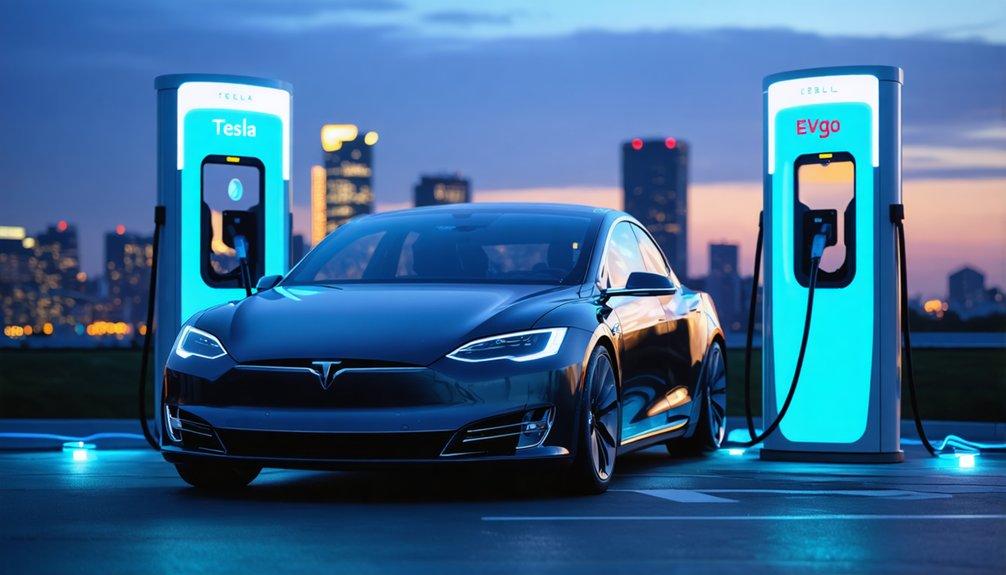

The electric vehicle market is surging, and EV charging networks are competing intensely. In 2025, ChargePoint, EVgo, and Electrify America have emerged as leaders, each excelling in different areas. A closer look at their strengths in coverage, charging speeds, pricing, and innovative features is necessary to determine which network is leading and what sets them apart.
Coverage is a key factor in the EV charging network competition. ChargePoint has the largest network, with over 200,000 charging spots across the US. EVgo has a strong presence on highways, while Electrify America is focusing on urban areas. Each network has its strengths, but they also have weaknesses that need to be addressed.
Charging speeds are another important consideration. EVgo has the fastest charging speeds, with some stations offering up to 350 kW. ChargePoint and Electrify America are also upgrading their charging speeds, but they still lag behind EVgo. Pricing is another factor that varies across networks. ChargePoint offers a pay-as-you-go model, while EVgo and Electrify America have subscription-based models.
Innovative features are also a key differentiator. ChargePoint has a user-friendly app that allows drivers to find charging stations and track their charging history. EVgo has a similar app, but it also offers a rewards program that incentivizes drivers to use its network. Electrify America is focusing on building a seamless charging experience, with features like plug-and-pay and automatic payment processing.
As the EV market continues to grow, the competition among charging networks will only intensify. “The key to success will be providing a seamless charging experience that is convenient, fast, and affordable,” says a industry expert. By examining the strengths and weaknesses of each network, drivers can make informed decisions about which network to use.
Ultimately, the leading EV charging network will be the one that provides the best overall experience for drivers. While each network has its strengths, they also have areas for improvement. By focusing on coverage, charging speeds, pricing, and innovative features, the top networks can differentiate themselves and attract more drivers to their networks.
Highlights
Leading EV Charging Networks in 2025
ChargePoint, EVgo, and Electrify America dominate the EV charging landscape, offering over 100,000 charging spots and prioritizing user experience. EVgo’s 98% uptime rate sets a high standard, while Electrify America focuses on seamless payment processes and user convenience.
Investing in High-Power Charging Infrastructure
The top networks are investing heavily in high-power charging infrastructure, capable of delivering up to 350 kW. This reduces charging time to under 30 minutes, making long-distance EV travel more practical. By investing in high-power charging, these networks are future-proofing their infrastructure and meeting the evolving demands of EV owners.
Pricing Strategies for Customer Retention
To attract and retain customers, EV charging networks are implementing innovative pricing strategies. These include adaptive pricing, membership models, and tiered plans. By offering flexible pricing options, networks can cater to different user needs and encourage loyalty.
Innovation and Accessibility
Continuous innovation and a focus on accessibility are crucial for EV charging networks to remain relevant. By prioritizing user-centric design and investing in emerging technologies, networks can meet the changing needs of EV owners and stay ahead of the competition.
Meeting Evolving Demands
As the EV market continues to grow, charging networks must adapt to meet evolving demands. By investing in high-power charging infrastructure, implementing flexible pricing strategies, and prioritizing innovation and accessibility, the top networks are well-positioned to lead the market in 2025.
“By prioritizing user experience and investing in emerging technologies, EV charging networks can drive growth and meet the evolving demands of the market.”
Top EV Charging Networks by Coverage and Availability
The electric vehicle (EV) market has experienced rapid growth, driving the expansion of EV charging networks. Three key players have emerged as leaders in coverage and availability: ChargePoint, EVgo, and Electrify America.
ChargePoint operates the largest network, with over 100,000 charging spots across the US. Its vast coverage provides EV owners with a reliable option for long-distance travel.
In contrast, EVgo prioritizes network reliability, boasting a 98% uptime rate. This focus on reliability is crucial for drivers who depend on these charging stations for daily commutes.
Electrify America has invested heavily in user experience, offering a seamless payment process and guidance through its mobile app. This attention to detail has earned the company a loyal customer base.
While each network has its strengths, they face a common challenge: meeting the growing demand for EV charging infrastructure.
According to Nicholas Wahl, an EV industry expert, “The next phase of EV adoption will be driven by the expansion of charging networks. Companies that prioritize user experience, reliability, and coverage will be best positioned to capitalize on this trend.”
As the EV market continues to grow, ChargePoint, EVgo, and Electrify America must innovate and improve their services to remain competitive. This includes upgrading existing infrastructure, expanding coverage, and enhancing the overall user experience.
By addressing these challenges, these companies can solidify their positions as leaders in the EV charging market.
Key Statistics:
- ChargePoint: over 100,000 charging spots across the US
- EVgo: 98% uptime rate
- Electrify America: seamless payment process and guidance through its mobile app
Recommendations:
- EV owners prioritize charging networks with reliable coverage and user-friendly interfaces.
- Companies investing in EV fleets should consider partnering with charging networks that offer comprehensive coverage and reliable services.
- As the EV market continues to grow, charging networks must prioritize innovation and improvement to remain competitive.
Charging Speeds Compared: From Level 2 to High-Power Charging
Charging speed is a crucial factor for electric vehicle owners, as it directly impacts the convenience and practicality of EV ownership. Charging speeds vary significantly across different networks. Level 2 charging, for instance, can take around 4-6 hours to fully charge a vehicle. In contrast, high-power charging can replenish a battery to 80% in under 30 minutes.
Leading EV charging networks are investing heavily in high-power charging infrastructure, offering power levels of up to 350 kW. As a result, EV owners can expect significant reductions in charging time, making long-distance travel more practical. This is particularly important for drivers who rely on their vehicles for extended trips or daily commutes.
By analyzing the charging speeds of different networks, EV owners can make informed decisions about which networks best meet their needs. For example, drivers who prioritize speed may prefer networks with high-power charging capabilities, while those who prioritize cost may opt for Level 2 charging.
Ultimately, understanding charging speeds is essential for EV owners to get the most out of their vehicles.
As Georg Ell, CEO of TÜV Rheinland, a global testing and certification company, notes, “High-power charging is a game-changer for electric vehicles, enabling drivers to charge their batteries to 80% in under 30 minutes. This technology has the potential to revolutionize the way we think about mobility and transportation.”
High-power charging is set to become increasingly important as the demand for electric vehicles continues to grow. As governments and companies invest in expanding the EV charging infrastructure, drivers can expect to see more high-power charging stations pop up along highways and in cities.
With the ability to charge quickly and conveniently, EV owners will be able to travel greater distances without worrying about running out of charge, making electric vehicles a more practical and appealing option for many drivers.
Pricing Strategies: A Look at Cost Per Charge and Membership Models
Balancing Profitability and Customer Demand: Pricing Strategies for EV Charging Networks
Electric vehicle (EV) charging networks face a complex challenge: structuring pricing to balance profitability with the need to attract and retain customers. To address this, leading networks employ adaptive pricing, which adjusts the cost per charge based on demand, location, and time of day. This approach enables networks to maximize revenue while incentivizing off-peak charging, reducing strain on the grid during peak hours.
Membership Models: A Key to Customer Loyalty
Membership models are another crucial aspect of pricing strategies, offering benefits like discounted rates, priority access, and streamlined payment processes. By providing a sense of belonging and loyalty rewards, membership programs encourage repeat business and cultivate a loyal customer base.
For instance, networks may offer tiered membership plans, with higher tiers providing exclusive perks, such as access to premium charging stations or dedicated customer support.
Effective Pricing Strategies for a Competitive Edge
Well-designed pricing strategies are fundamental for EV charging networks to maintain a competitive edge and support the growing demand for electric vehicles. As the EV market continues to expand, networks must adapt their pricing models to meet evolving customer needs and stay ahead of the competition.
Innovative Features and Technologies: A Key Differentiator
Innovative Features and Technologies Set EV Charging Networks Apart
As the EV charging landscape continues to expand, innovative features and technologies are becoming a key differentiator for networks looking to stand out in a crowded market. Industry leaders are focusing on seamless payment systems, streamlined charging processes, and improved user experiences.
Mobile apps now allow users to easily locate charging stations, initiate charging sessions, and monitor their energy consumption in real-time. Some networks have implemented loyalty programs, rewards, and personalized charging plans, fostering a sense of community among EV owners.
Others prioritize accessibility, incorporating wheelchair-accessible charging stations and audio assistance for visually impaired users. By investing in these innovative features and technologies, EV charging networks can establish a strong market presence, attract loyal customers, and drive growth in the industry.
This trend is expected to continue, with user-centric design and seamless payment experiences becoming increasingly important. According to industry experts, “The future of EV charging will be shaped by the ability of networks to provide a seamless, user-friendly experience that meets the evolving needs of EV owners.”
Prioritizing Accessibility and User Experience
The incorporation of accessibility features, such as wheelchair-accessible charging stations and audio assistance, is a significant step forward for the industry. These features not only improve the overall user experience but also ensure that EV ownership is accessible to a wider range of people.
Driving Growth through Innovation
The Future of EV Charging: Expansion Plans and Emerging Trends
Electric Vehicle Charging Expansion Plans and Emerging Trends
The demand for electric vehicles (EVs) is increasing, driven by government initiatives to reduce carbon emissions. In response, industry leaders are investing in EV charging infrastructure to strengthen their networks and cater to the growing number of EV adopters.
Charging networks are focusing on user accessibility, introducing seamless payment systems, intuitive mobile apps, and strategically located charging stations.
Advancements in Charging Technology
The market is also witnessing the exploration of emerging technologies like vehicle-to-grid (V2G) charging and advanced energy storage solutions.
These innovations aim to improve the overall user experience, increase efficiency, and provide a competitive edge for charging networks. By incorporating these technologies, charging networks can enhance their services and stay ahead in the industry.
Strategic Expansion and Innovation
Strategic expansion and innovation are crucial in shaping the future of EV charging.
Charging networks must prioritize infrastructure investment, user accessibility, and emerging technologies to remain competitive. As the market continues to evolve, it is essential for charging networks to adapt and innovate to meet the growing demands of EV adopters.
“The future of EV charging relies on the ability of charging networks to adapt, innovate, and prioritize user accessibility and emerging technologies.”
The future of EV charging is expected to be shaped by the continued emphasis on user accessibility, innovation, and strategic expansion.
As the demand for EVs continues to grow, charging networks must invest in their infrastructure and services to meet the evolving needs of their users.
Conclusion
The electric vehicle (EV) charging landscape in 2025 is led by ChargePoint, EVgo, and Electrify America, each with its strengths in different areas. These networks focus on improving user experience, investing in high-power charging technology, and implementing adaptive pricing strategies. Their emphasis on innovation and expansion prepares them to meet the growing demand for EV charging, shaping the future of sustainable transportation.
ChargePoint excels in providing a comprehensive charging network, while EVgo focuses on high-power charging corridors along highways. Electrify America, on the other hand, is investing heavily in building a robust charging infrastructure across the US. By prioritizing user experience, these networks are making long-distance EV travel more practical.
As the industry evolves, we can expect even faster charging times, more convenient payment options, and greater accessibility. With governments worldwide setting ambitious targets for EV adoption, the demand for reliable charging infrastructure will continue to grow. ChargePoint, EVgo, and Electrify America are well-positioned to lead this growth, driving the transition towards a more sustainable transportation sector.
“The future of transportation is electric, and it’s happening now. EV charging networks like ChargePoint, EVgo, and Electrify America are at the forefront of this shift, making it easier for people to switch to electric vehicles,” says an industry expert. As these networks continue to expand and innovate, they will play a critical role in shaping the future of transportation.